

Disclosure: This post contains affiliate links. If you sign up through them, I may earn a small commission at no extra cost to you. I only recommend tools I’ve researched in depth.
Most email marketing tools make you choose between affordable and capable. Pay less, and you get a watered-down editor with locked automation. Pay more, and you’re staring at an enterprise dashboard built for a team of ten — when you’re a business of one.
Campaigner sits in a different lane. It’s been around since 2004, which means it’s had two decades to figure out what growing businesses actually need from email marketing. The question isn’t whether it’s a serious platform — it clearly is. The question is whether it’s the right fit for your business in 2026.
I dug into the pricing, tested the feature set, and compared it against the two tools people most often switch from — Mailchimp and ActiveCampaign. Here’s what I found.
Try Campaigner free for 30 days →
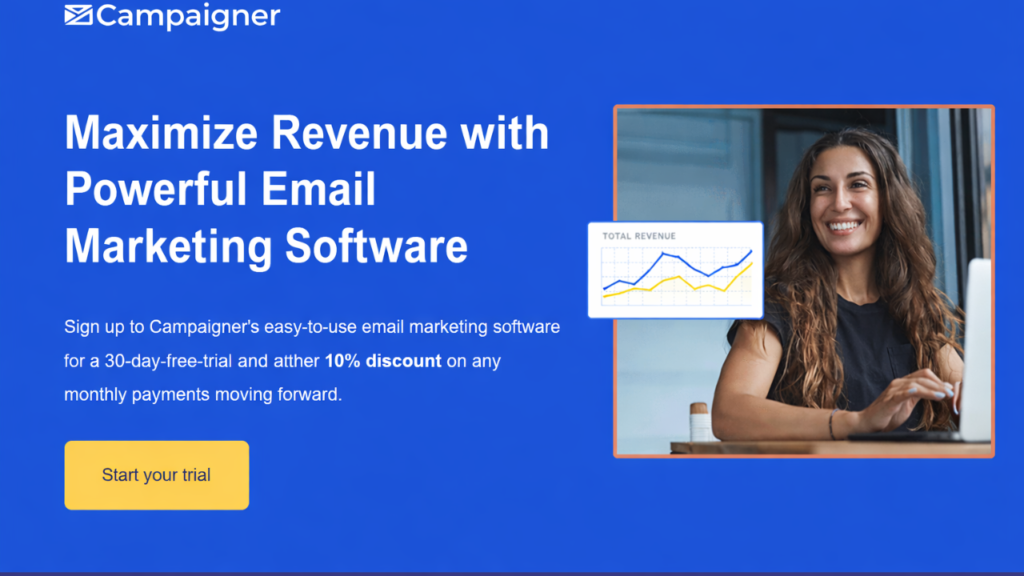
What Is Campaigner?
Campaigner is an email and SMS marketing platform built for small to mid-sized businesses that have outgrown basic newsletter tools but don’t need a full enterprise CRM.
It started as a bulk email platform known for deliverability and compliance. Between 2016 and 2022, the team added visual automation builders, segmentation tools, and integrations with Shopify, Salesforce, and major CRMs. By 2023, AI-powered subject line suggestions and dynamic content features made it into the product. Today it positions itself as a multi-channel automation platform — not just a tool for sending emails, but a system for managing customer communication across email and SMS in one workspace.
That positioning makes sense for a specific type of business. More on who that is below.
Campaigner Pricing in 2026: What You Actually Pay
Campaigner uses contact-based pricing — your monthly cost depends on the size of your subscriber list.
Here’s the breakdown at 1,000 contacts:
| Plan | Monthly Cost | What’s Included |
|---|---|---|
| Essentials | $14/month | Drag-and-drop editor, templates, basic reporting |
| Advanced | $35/month | Automation workflows, advanced segmentation, A/B testing |
| eCommerce | $79.95–$149.95/month | Shopify + Magento integration, unlimited contacts |
| Custom (Enterprise) | Contact sales | Full feature suite, dedicated account manager |
Two things most reviews skip over:
First, pricing scales with your contact list. The $14/month figure is for 1,000 subscribers. If you have 10,000 subscribers, your cost increases significantly. Always check the pricing page with your actual list size before assuming.
Second, SMS is not included by default. If you want email and SMS bundled together, expect to add roughly $45/month on top of your existing plan.
The 30-day free trial gives you full feature access before committing. You do need to enter a credit card upfront — your card isn’t charged unless you keep the plan after the trial ends. There is no free plan once the trial period ends.
Key Features Breakdown
Drag-and-Drop Email Builder
Campaigner’s editor is clean and doesn’t require any coding knowledge. You can build responsive emails — ones that look right on both desktop and mobile — using pre-built blocks for images, text, buttons, and dividers. A library of customizable templates speeds up the process further.
This isn’t the flashiest editor on the market, but it’s solid and reliable. If you’ve used Mailchimp’s builder, you’ll find it familiar.
Marketing Automation
This is where Campaigner earns its price tag. The visual workflow builder lets you create behavior-triggered sequences — welcome series, abandoned cart emails, post-purchase follow-ups, re-engagement campaigns — without writing a single line of code.
You set the trigger (someone joins your list, clicks a link, makes a purchase), define the conditions, and map out the sequence. The interface is visual and logical, which matters when you’re building multi-step flows.
Important: Automation workflows are only available on the Advanced plan ($35/month) and above. If you sign up for Essentials, you won’t have access to this feature. For most businesses, the Advanced plan is the one worth considering.
Segmentation
Campaigner lets you segment your audience based on:
- Demographics and location
- Email engagement history (opens, clicks)
- Purchase history and behavior
- Custom fields you define yourself
Good segmentation is the difference between a 5% open rate and a 30% open rate. Sending the same email to your entire list in 2026 is a fast way to train your subscribers to ignore you. Campaigner’s segmentation tools are among the stronger ones in this price range.
Email and SMS in One Platform
Rather than managing email through one tool and SMS through another — and trying to keep the data synced — Campaigner keeps both channels in one workspace. Your automation, reporting, and audience data all stay connected.
For businesses that use SMS for time-sensitive promotions or appointment reminders, this is a meaningful advantage over platforms that treat SMS as an afterthought.
Deliverability
Campaigner has 20+ years of deliverability infrastructure behind it. That matters more than most people realize. A beautifully designed email that lands in the spam folder is worth exactly nothing. Campaigner consistently ranks well for inbox placement, which is a core reason enterprise users specifically name it when discussing reliable sending.
Reporting and Analytics
Every plan includes reporting on open rates, click-through rates, bounce rates, and subscriber behavior. Higher tiers add more granular data. You can see which links got clicked, which segments performed best, and how individual campaigns performed over time.
What Campaigner Does Not Do Well
No Mobile App
As of 2026, there is no dedicated Campaigner mobile app. If you want to check campaign stats or make quick edits from your phone, you’re working in a mobile browser — which is functional but not ideal. Mailchimp and ActiveCampaign both have proper mobile apps. For business owners who manage their marketing on the go, this is a genuine gap.
Smaller Integration Marketplace
Campaigner connects with the major platforms — Shopify, Magento, Salesforce, and a handful of CRMs. But compared to ActiveCampaign or HubSpot, the native integration library is smaller. If you use niche or industry-specific software, you’ll likely need to connect through Zapier or the API rather than a direct native integration.
Essentials Plan Has Real Limitations
The $14/month entry point looks attractive, but the Essentials plan doesn’t include automation workflows. For a platform that’s built around automation, paying for a plan that doesn’t include it defeats much of the purpose. Budget for the Advanced plan ($35/month) if you want to use Campaigner the way it’s designed to be used.
Support Consistency Varies
Campaigner offers 24/7 email support and live chat, but response times aren’t always consistent — particularly on lower-tier plans during peak periods. Higher-tier plans get faster, more dedicated support. If reliable support turnaround is critical to your business, factor that into your plan decision.
How Campaigner Compares to the Competition
Campaigner vs. Mailchimp
Mailchimp wins on accessibility. Its free plan (up to 500 contacts) is genuinely useful for businesses just getting started, and the interface is one of the most beginner-friendly in the industry.
Campaigner wins on automation depth and deliverability. Once you’ve outgrown Mailchimp’s automation limits on a basic plan — which happens faster than you’d expect — Campaigner becomes the natural upgrade. The workflow builder is more capable, the segmentation is more robust, and the deliverability track record is stronger.
Who should choose Mailchimp: Businesses under 500 subscribers who want a free starting point. Who should choose Campaigner: Businesses with a growing list who need real automation and don’t want to pay ActiveCampaign prices.
Campaigner vs. ActiveCampaign
ActiveCampaign has deeper automation capabilities, a built-in CRM, and one of the largest integration marketplaces in the email marketing space. It’s a genuinely powerful platform.
It’s also more expensive and more complex. ActiveCampaign starts at $49/month, and meaningful automation features push you into higher tiers quickly. There’s also a steeper learning curve.
Campaigner is simpler, cheaper, and covers 80% of what most SMBs actually need from automation. If you don’t need a built-in CRM and your integrations are with mainstream tools, Campaigner saves you money without meaningful sacrifice.
Who should choose ActiveCampaign: Businesses that need deep CRM integration, complex multi-branch automation, or a vast integration marketplace. Who should choose Campaigner: Businesses that want strong automation and segmentation without paying enterprise prices or climbing a steep learning curve.
Who Should Use Campaigner
Campaigner is a strong fit if you:
- Have between 1,000 and 25,000 subscribers and need real automation
- Run an ecommerce store and want behavior-triggered email sequences
- Want email and SMS managed in the same platform
- Care about deliverability more than having the flashiest UI
- Have outgrown Mailchimp but find ActiveCampaign’s pricing hard to justify
It’s not the right choice if you:
- Have under 500 subscribers and just need a basic newsletter tool (Mailchimp’s free plan wins)
- Frequently manage campaigns from a mobile device
- Depend on a wide range of niche app integrations
- Need a built-in CRM alongside your email marketing

Final Verdict
Campaigner isn’t trying to be the cheapest tool or the most feature-packed one. It’s trying to be the most capable platform in its price range for businesses that take email marketing seriously.
For that specific audience — small and mid-sized businesses with real lists, real automation needs, and an eye on deliverability — it delivers. The Advanced plan at $35/month for 1,000 contacts is genuinely competitive when you compare what you’re getting against Mailchimp’s paid tiers or ActiveCampaign’s starting price.
The lack of a mobile app and the smaller integration marketplace are real limitations. But if those don’t apply to how you work, Campaigner is worth taking seriously.
The 30-day free trial is the lowest-risk way to find out. You’ll know within a week whether the automation builder clicks with how you think and whether the platform fits your workflow.
Start your free 30-day Campaigner trial here →

Muse runs BikoMarketing, a publication focused on helping small
business owners and solo founders choose the right marketing tools,
build their tech stack, and grow without overspending on software
they don’t need.
Coverage includes email marketing platforms, marketing automation,
SaaS reviews, and tech recommendations — written for people who
want real answers, not marketing fluff.
📩 contact@bikomarketing24@gmail.com