

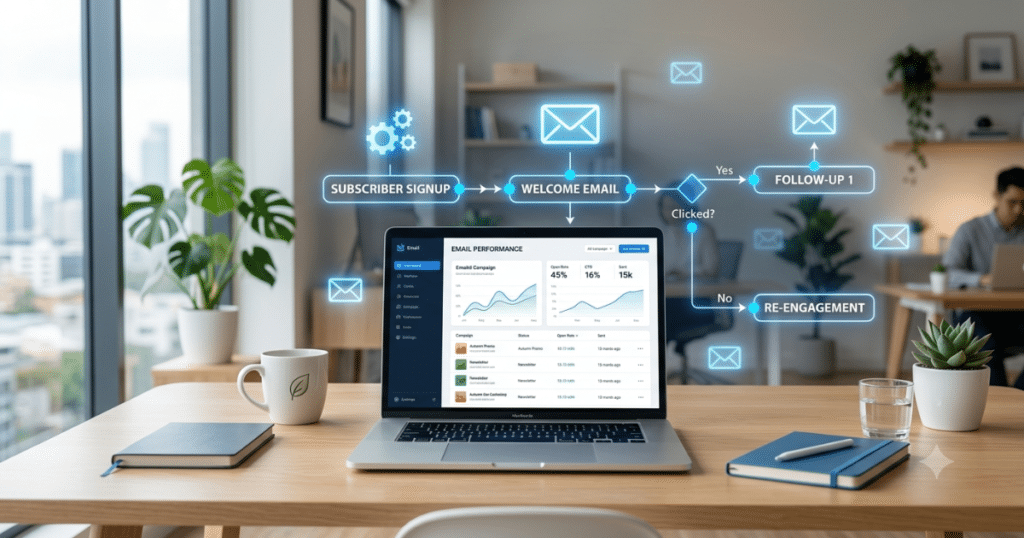
Email automation for beginners is one of the simplest and most powerful ways to grow your business on autopilot. Whether you’re starting a blog, launching a brand, or building an online presence, automated emails help you connect with your audience, deliver value consistently, and increase conversions without doing extra work. In 2026, email remains the highest‑ROI marketing channel, and automation makes it even more effective — especially for beginners who want fast, scalable results.
Here is the uncomfortable truth about manual email marketing: it does not scale.
You write an email. You send it. You get results for a day, maybe two. Then everything goes quiet, and you start again from scratch. It is the digital equivalent of fishing with a rod instead of a net — slow, exhausting, and completely dependent on you showing up every single time.
Email automation is the net.
You build it once. You set it up correctly. Then it runs — welcoming new subscribers, nurturing leads, recovering abandoned carts, re-engaging inactive customers — whether you are working, sleeping, or on holiday. And the results are not marginal. <cite index=”23-1″>Automated emails drive 320% more revenue than non-automated emails.</cite> That is not a rounding error. That is a fundamental difference in how the same channel performs depending on whether you are using it manually or systematically.
This guide is for small business owners and beginners who want to understand email automation properly — what it is, how it works, which sequences to build first, and the mistakes that kill results before they start.
What Email Automation Actually Is (No Jargon)
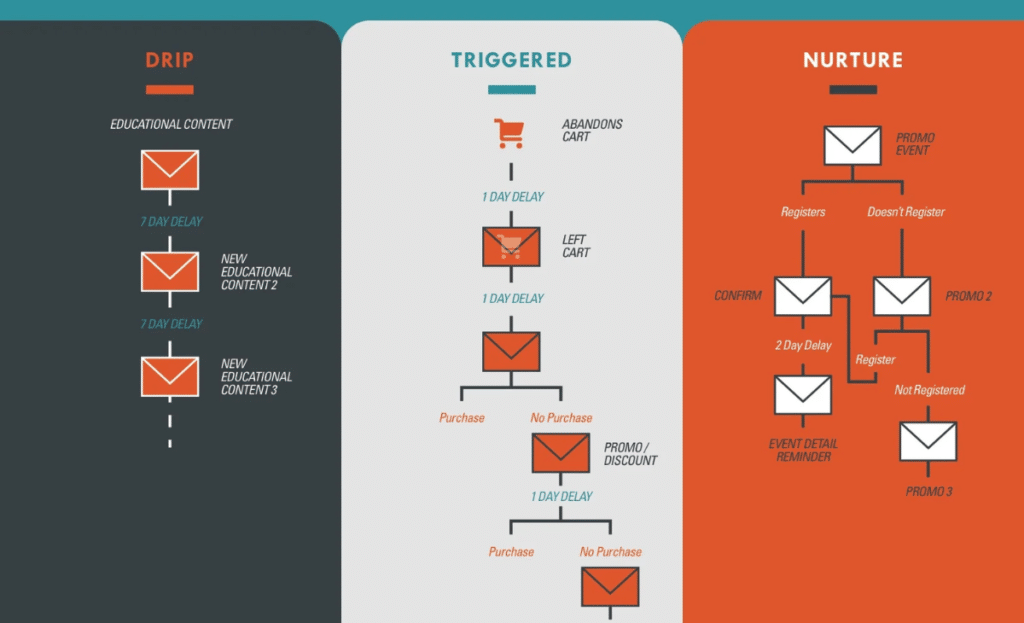
Email automation is a system that sends pre-written emails to your subscribers automatically, triggered by something they do — or do not do.
The keyword is triggered. Unlike a regular email broadcast (where you sit down, write something, and hit send to your whole list), automated emails fire in response to a specific action or condition.
Someone joins your list → they get a welcome email. Someone downloads your free guide → they enter a nurture sequence. Someone visits your pricing page three times without buying → they get a targeted follow-up. Someone has not opened an email in 90 days → they enter a re-engagement sequence.
None of that requires you to be at a keyboard. You write the emails once, set the triggers, and the system handles the rest.
That is the core idea. Everything else is just the application of that idea to different situations in your business.
Why Small Businesses Cannot Afford to Ignore Automation in 2026
<cite index=”27-1″>According to a 2026 Constant Contact survey of small business owners across five countries, 41% expect email marketing to be their most valuable marketing channel this year.</cite> That number has been climbing steadily — and the automation component is a significant reason why.
Here is what the data shows when you compare automated email performance against manual campaigns:
<cite index=”23-1″>Triggered emails perform three times better than batch-and-blast emails. Drip campaigns have three times higher click-through rates than one-time sends.</cite> And for e-commerce specifically, <cite index=”25-1″>abandoned cart, welcome, and browse abandonment emails account for 87% of all automated orders — despite being a tiny fraction of total email volume.</cite>
The gap between manual and automated is not a matter of working harder on your email copy. It is a structural difference. Automated emails arrive at the exact moment a subscriber is most likely to engage — right after they take an action, right when their interest peaks, right when your message is most relevant. Manual emails arrive whenever you get around to sending them.
For a small business with limited time and no marketing team, automation is not a luxury. It is how you compete.
The Anatomy of an Email Automation: Trigger, Condition, Action
Every automation — no matter how simple or complex — has the same three-part structure.
The trigger is the event that starts the sequence. A subscriber joins your list. Someone clicks a specific link. A customer makes a purchase. A contact has not opened an email in 60 days. The trigger is the condition that says “start here.”
The condition is an optional filter that narrows who the automation applies to. Not every subscriber who joins your list should get the same welcome sequence if you serve multiple audiences. Conditions let you route different people into different paths based on what you know about them.
The action is what happens — which email gets sent, when it gets sent, and what happens next. Most automation builders let you add delays, branch logic (if they clicked this, send that; if they did not, send something else), and tags that update the subscriber’s profile based on their behavior.
Understanding this structure matters because it changes how you think about building automations. You are not just writing emails. You are designing a decision tree that responds to real human behavior.
The 6 Automated Sequences Every Small Business Should Have
Not all automations are equal. Some deliver outsized returns on minimal setup time. These six cover most of what a small business needs to run a complete, functional email marketing system.
1. The Welcome Sequence
This is the most important automation you will ever build. <cite index=”23-1″>The average open and click-through rates for welcome emails are 82–83.6% and 27% respectively</cite> — numbers that no regular campaign will ever come close to matching.
Why? Because welcome emails arrive at the moment of peak interest. The person just signed up. They want to hear from you. They are paying attention in a way they will never pay attention again as a casual subscriber.
A complete welcome sequence runs five to seven emails over ten days:
Email 1 (immediately): Deliver what they signed up for. Thank them for joining. Tell them exactly what to expect — how often you will email, what topics you cover, and what they will get from staying subscribed. Set the tone. This is your first impression.
Email 2 (Day 2): Your story. Not a credentials list — a human narrative. Why do you do this work? What problem were you trying to solve that led you here? Connecting your origin to their problem builds the kind of trust that a product page never will.
Email 3 (Day 4): Teach something genuinely useful. A framework, a tactic, a reframe — something they can apply today. This email does more for your credibility than any testimonial because it demonstrates that you can actually help, before they spend a dollar.
Email 4 (Day 6): Social proof. A specific client or customer story, told with real details — the situation they were in, what changed, and the concrete result. Vague testimonials (“It was great!”) do nothing. Specific ones (“I increased my conversion rate from 1.2% to 3.8% in six weeks”) are enormously persuasive.
Email 5 (Day 8): A soft offer. The first mention of how they can work with you or buy from you. Low pressure, high relevance. “If you’re ready to take this further, here’s how I can help.”
Email 6 (Day 10): Ask a question. “What’s the biggest challenge you’re facing with [their problem] right now?” Replies from this email are gold — they tell you exactly what language resonates with your audience and who is closest to buying.
2. The Lead Nurture Sequence
Not everyone who joins your list is ready to buy. Some people are early in their research. Some are comparing options. Some are just curious. A nurture sequence keeps you in front of these people, building trust and demonstrating value over weeks — so that when they are ready to buy, you are the obvious choice.
A five-email nurture sequence:
- Email 1: Introduce your core philosophy or approach
- Email 2: Teach the most important concept in your area
- Email 3: Share a case study or customer result
- Email 4: Address the most common objection directly
- Email 5: Clear invitation to take the next step
The key is specificity. Generic nurture emails (“Here are some tips!”) do not move people. Emails that speak to a specific situation your subscriber is in, using language that reflects how they think about their problem, create the feeling that you understand them better than anyone else does.
3. The Abandoned Cart Sequence
For e-commerce businesses, this is the single highest-ROI automation available. <cite index=”23-1″>Abandoned cart emails achieve an average open rate of 50.5% and recover 3–5% of lost sales on average. Sending three emails in sequence recovers 69% more orders than sending just one.</cite>
The three-email structure:
Email 1 (1 hour after abandonment): A simple reminder. No pressure. “You left something behind.” Include the product image, name, and price. Make it easy to pick up where they left off.
Email 2 (24 hours later): Social proof and reassurance. Customer reviews of the specific product they left behind. Answer the most common objections — sizing, returns policy, and quality questions.
Email 3 (48–72 hours later): Final nudge. A light sense of urgency if you have genuine scarcity (limited stock, a sale ending). If you do not have real scarcity, do not manufacture it — subscribers notice, and it erodes trust.
4. The Post-Purchase Sequence
Most businesses stop communicating the moment someone buys. That is a mistake. The period immediately after a purchase is when a customer’s enthusiasm is highest,t and their likelihood of becoming a repeat buyer is greatest.
A post-purchase sequence does three things:
First, it confirms the purchase and sets expectations for delivery or access. Clarity here prevents support tickets and buyer anxiety.
Second, it onboards the customer — helps them actually use what they bought and get value from it quickly. Customers who get fast results become loyal customers. Customers who never figure out how to use the product churn.
Third, it plants the seed for the next purchase. Not immediately and not aggressively — but within two to three weeks, introducing them to a complementary product or service naturally.
5. The Re-Engagement Sequence
<cite index=”26-1″>88% of users check their email every day.</cite> But they do not open every email. Subscribers go inactive for dozens of reasons — they got busy, their interests shifted, your subject lines stopped resonating. A re-engagement sequence attempts to bring them back before they disengage permanently.
Three emails over two weeks:
Email 1: A direct acknowledgment. “We have not heard from you in a while. Still interested in [topic]?” Offer something fresh and valuable.
Email 2 (five days later): Your best content. Your most popular post, your most useful framework, your strongest piece of value. If this does not bring them back, nothing will.
Email 3 (five days later): The breakup email. “This is the last time I’ll contact you unless you’d like to stay subscribed.” Give them a one-click option to remain on your list.
Subscribers who do not engage with any of these three emails should be removed. A clean list of engaged subscribers outperforms a bloated list of unresponsive contacts in every meaningful metric — and protecting your sender reputation matters enormously for deliverability.
6. The Referral Sequence
Your happiest customers are your best marketing channel. A referral sequence, triggered two to four weeks after a successful purchase, asks satisfied customers to share your business with someone they know.
The timing matters. Ask too early, and the customer has not had time to see results. Ask too late, and the enthusiasm has faded. The sweet spot is shortly after a positive experience — a completed onboarding, a first result achieved, a milestone reached.
Keep the ask simple. A single sharing link, a one-sentence description of what to say, and a clear explanation of any referral incentive you offer.
How to Set Up Your First Automation: Step by Step
The process looks the same regardless of which email platform you use.
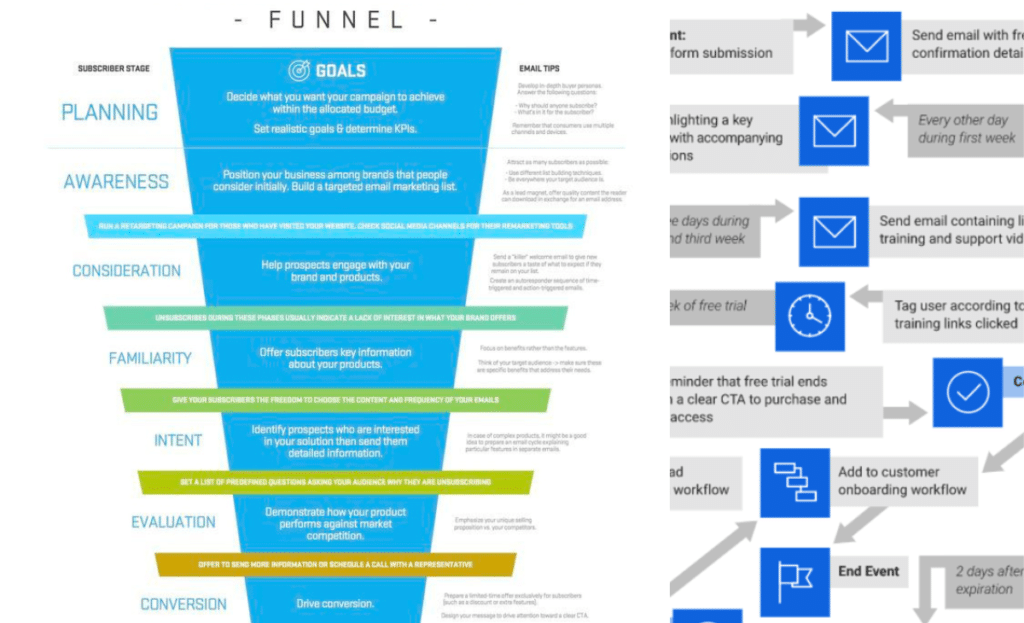
Step 1: Choose your starting point. For most small businesses, the welcome sequence is the right first automation. It is the highest-impact place to start, and it gives you a foundation that everything else connects to.
Step 2: Write the emails first. Open a Google Doc and write all five to seven emails before touching your email platform. This is faster than writing them directly in the builder, and it helps you see the sequence as a whole rather than as individual messages.
Step 3: Set up your trigger. In your email platform, create a new automation and select the trigger: “When someone subscribes to my list” or “When someone joins [specific tag or segment].”
Step 4: Add the emails with delays. Load each email into the automation builder, setting the delay between each one — immediately, two days, two days, two days, two days.
Step 5: Test it on yourself. Subscribe to your own list using a personal email address. Go through the whole sequence as a subscriber. Read every email. Check every link. Find anything that feels off and fix it before real subscribers see it.
Step 6: Turn it on and monitor it. For the first two weeks, check the open rates and click rates of each email daily. A sharp drop-off at a specific email signals a problem — a weak subject line, a confusing message, a broken link.
The Metrics That Tell You Whether Your Automation Is Working
Most beginners track open rates and stop there. Open rates matter, but they are only the first step.
Open rate tells you whether your subject line works. A healthy automated email open rate is 40–50% for welcome emails, 25–35% for ongoing nurture sequences. Anything significantly below these numbers suggests a subject line problem or a deliverability issue.
Click-through rate tells you whether your content is compelling enough to make someone take action. <cite index=”30-1″>Automated email campaigns achieve an average click rate of 5.4%</cite> — consistently higher than manual broadcasts. Below 2% usually means the call to action is unclear, or the email content is not relevant enough to the link you are promoting.
Conversion rate tells you whether clicks turn into the action you wanted — a purchase, a booking, a sign-up. This is the metric that actually connects to revenue.
Unsubscribe rate tells you whether you are sending the right content to the right people. A spike in unsubscribes from a specific email usually means the content was irrelevant, the frequency was too high, or the offer did not match the expectation you set at sign-up.
The Mistakes That Kill Automation Results
Sending the same sequence to everyone. A new subscriber who downloaded a beginner’s guide has completely different needs from a subscriber who has been on your list for six months and clicked your pricing page twice. Segment from day one, even if your initial segments are simple.
Writing for yourself instead of your reader. Every automated email should be written from the subscriber’s perspective — what do they need to know right now, at this moment in their journey? Not what you want to tell them.
Ignoring mobile. <cite index=”26-1″>50% of people will delete an email if it is not optimized for mobile.</cite> Every email you write should be checked on a phone before it goes anywhere near an automation trigger.
Setting it and completely forgetting it. Automations need maintenance. Subject lines that worked in 2024 may not work in 2026. Offers that converted last year may be outdated. Review your sequences every six months — check the data, update anything stale, and look for drop-off points that signal a fixable problem.
Treating automation as a replacement for genuine communication. Automation handles consistency. It does not replace relevance. The most effective automated sequences feel personal, specific, and human — because they are written that way, even if they are triggered automatically.
Where to Go From Here
If you are starting from nothing, the path is straightforward.
Pick one email platform. Write a five-email welcome sequence. Set it up with proper triggers. Subscribe with a test account and walk through it yourself. Fix what does not work. Then turn it on.
That is the entire starting point. One sequence, running automatically, does the work of a manual email marketer while you focus on the rest of your business.
Once the welcome sequence is live and working, add the re-engagement sequence next. Then, the abandoned cart sequence is f you run an e-commerce store. Then the post-purchase sequence. Each one you add compounds the value of the ones that came before it.
<cite index=”24-1″>Automated campaigns demonstrate dramatically higher conversion rates than traditional campaigns.</cite> The gap between businesses that use automation properly and those that rely on manual email is only getting wider as the tools improve and the competition intensifies.
Start now. Build it once. Let it work.
Email Automation for Beginners: The Easy Method to Boost Engagement in 2026
Email Automation for Beginners: The Easy Method to Boost Engagement in 2026
Email Automation for Beginners: The Easy Method to Boost Engagement in 2026
Email Automation for Beginners: The Easy Method to Boost Engagement in 2026
Email Automation for Beginners: The Easy Method to Boost Engagement in 2026
Email Automation for Beginners: The Easy Method to Boost Engagement in 2026
Email Automation for Beginners: The Easy Method to Boost Engagement in 2026
Email Automation for Beginners: The Easy Method to Boost Engagement in 2026
Email Automation for Beginners: The Easy Method to Boost Engagement in 2026
Email Automation for Beginners: The Easy Method to Boost Engagement in 2026
Email Automation for Beginners: The Easy Method to Boost Engagement in 2026
Email Automation for Beginners: The Easy Method to Boost Engagement in 2026
Email Automation for Beginners: The Easy Method to Boost Engagement in 2026
Email Automation for Beginners: The Easy Method to Boost Engagement in 2026
Email Automation for Beginners: The Easy Method to Boost Engagement in 2026
Email Automation for Beginners: The Easy Method to Boost Engagement in 2026
Email Automation for Beginners: The Easy Method to Boost Engagement in 2026
Email Automation for Beginners: The Easy Method to Boost Engagement in 2026
Email Automation for Beginners: The Easy Method to Boost Engagement in 2026
Email Automation for Beginners: The Easy Method to Boost Engagement in 2026
Email Automation for Beginners: The Easy Method to Boost Engagement in 2026
Email Automation for Beginners: The Easy Method to Boost Engagement in 2026
Email Automation for Beginners: The Easy Method to Boost Engagement in 2026
Email Automation for Beginners: The Easy Method to Boost Engagement in 2026
Email Automation for Beginners: The Easy Method to Boost Engagement in 2026
Email Automation for Beginners: The Easy Method to Boost Engagement in 2026
Email Automation for Beginners: The Easy Method to Boost Engagement in 2026
Email Automation for Beginners: The Easy Method to Boost Engagement in 2026
Email Automation for Beginners: The Easy Method to Boost Engagement in 2026
Email Automation for Beginners: The Easy Method to Boost Engagement in 2026
Email Automation for Beginners: The Easy Method to Boost Engagement in 2026
Email Automation for Beginners: The Easy Method to Boost Engagement in 2026
Muse runs BikoMarketing, a publication focused on helping small
business owners and solo founders choose the right marketing tools,
build their tech stack, and grow without overspending on software
they don’t need.
Coverage includes email marketing platforms, marketing automation,
SaaS reviews, and tech recommendations — written for people who
want real answers, not marketing fluff.
📩 contact@bikomarketing24@gmail.com